
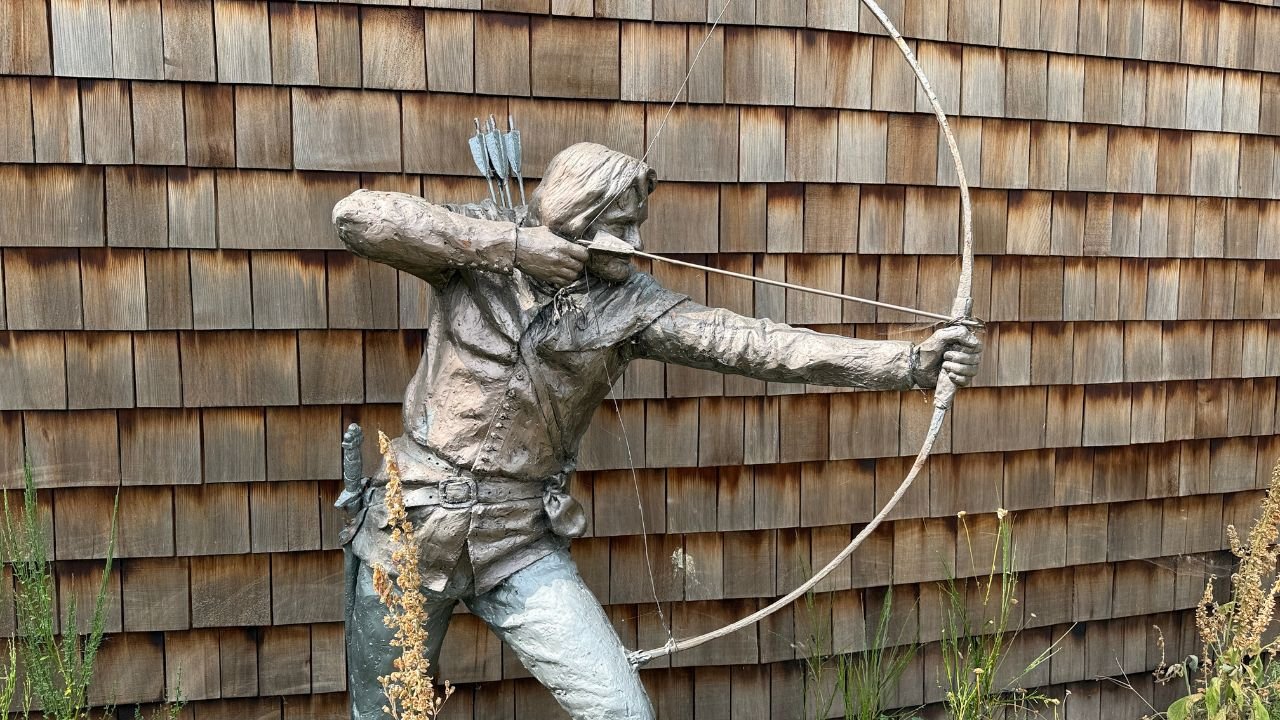
Join Mrs PJ and me as we visit the legendary Major Oak in the heart of Sherwood Forest, the ancient tree forever linked with the legend of Robin Hood and his Merry Men.
Sadly, after standing for around 1,200 years, the Major Oak has now officially been declared dead. But even without its leaves, it remains one of Britain's most incredible natural landmarks and is still home to countless insects, fungi and wildlife.
This mighty English Oak has attracted visitors from all over the world for decades.
They have stood and admired its vast form and wondered whether Robin Hood and his outlaws did hide within the trunk to escape the clutches of the Sheriff of Nottingham, as the legends suggest.
It is arguably the best known and certainly one of the biggest oak trees in Britain, with a canopy spread of 28 metres at its’ peak vitality, a trunk circumference of 11 metres and an estimated weight of 23 tonnes.
Sherwood Forest Visitor Centre offers everything you need for a great day out, including a café serving hot and cold refreshments, a gift shop with Robin Hood souvenirs, clean toilet facilities, accessible amenities, and ample parking. Families can enjoy the woodland play area and picnic spots, while well-marked walking trails lead visitors through the ancient forest to the world-famous Major Oak.
The Major Oak
Edwinstowe, Mansfield NG21 9PF
From 2022 onwards, the tree suffered from summer heat waves and produced progressively fewer leaves. Rumours of the tree's decline were initially denied by the RSPB, which manages the forest. However, its death was officially confirmed by the RSPB in June 2026, after prolonged stress from a succession of hot, dry summers caused it to fail to produce any leaves that year. The RSPB attributed part of the blame to the scaffolding, which had artificially forced the tree to pump water towards its propped-up branches – at the expense of its trunk – rather than allowing it to shed branches naturally and begin "growing down", as would be expected for a tree of its age. Additional contributing factors included soil compaction resulting from two centuries of tourist and vehicular traffic, and alterations to the water table caused by nearby coal mining.
The Major Oak is situated within a Site of Special Scientific Interest and will remain standing rather than being felled